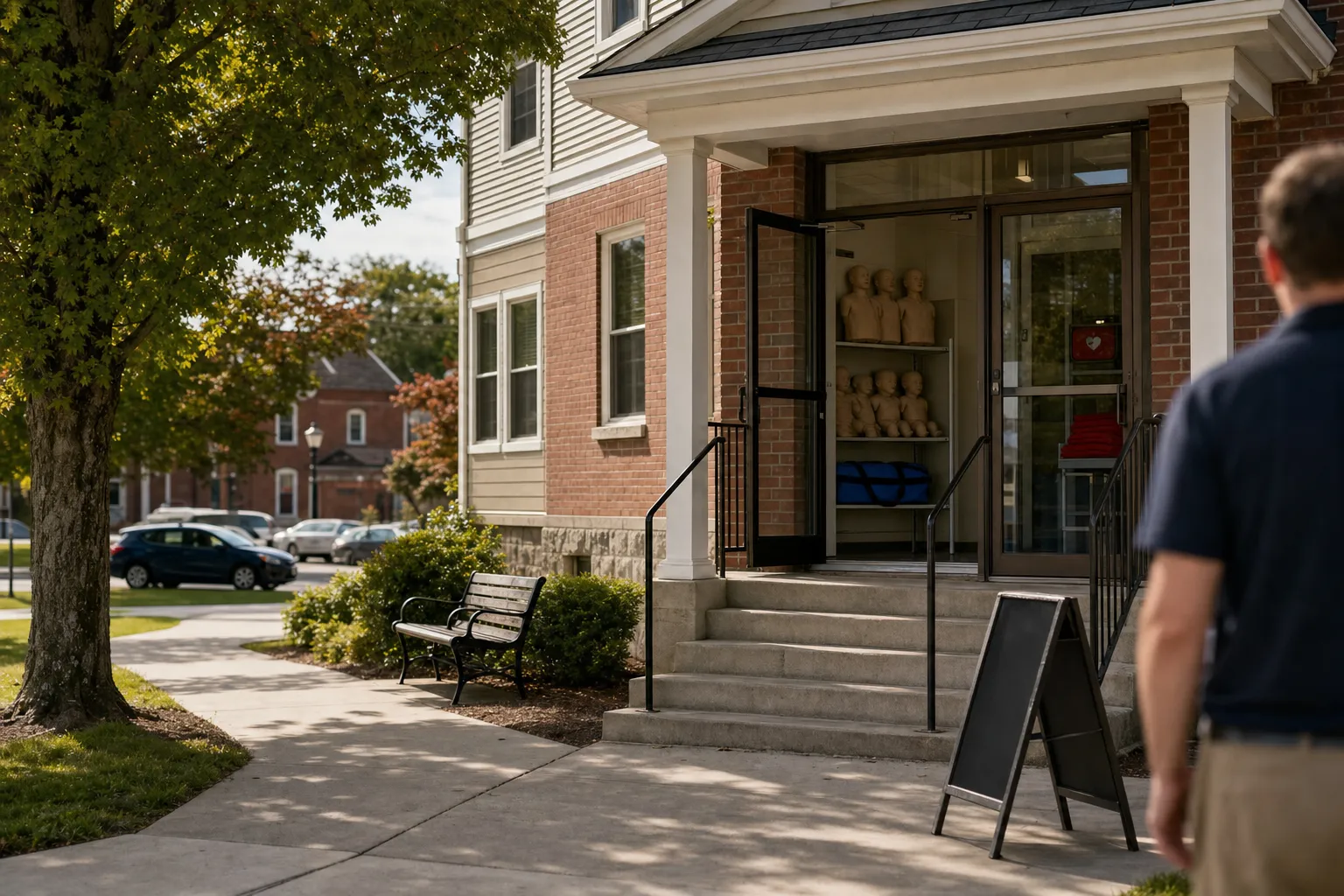
Training accessibility matters because it determines who can learn and use life saving skills. Accessible CPR certification removes unnecessary barriers, aligns training with legal and workplace requirements, and improves real world readiness in Cross Roads Pennsylvania and nearby communities.
What training accessibility means for CPR certification
Training accessibility is about making classes, materials and assessments usable by people with a wide range of abilities, backgrounds and schedules. That includes physical access to the classroom, alternative formats for learning materials, flexible pacing, and assessment methods that measure skill not advantage.
We use inclusive design so people with mobility limitations, hearing or vision differences, limited English proficiency, or neurodiverse learning styles can complete certification with the same competence as other learners.
Why accessibility matters here in Cross Roads and Stewartstown
In communities like Cross Roads and Stewartstown, first responders, school staff, childcare providers and family caregivers are often the first on scene. If training excludes people who fill those roles, the community loses potential lifesavers.
Accessible courses support local employers, schools and faith groups that must meet safety expectations. They also help volunteers and family members gain the confidence to act in an emergency. Our instructors design classes to be realistic for local settings, whether a classroom in Stewartstown or a childcare center in nearby neighborhoods.
Key concepts you should know
- Physical access. Clear paths, accessible seating and available adaptive aids so everyone can practice compressions and AED placement.
- Multiple learning modes. Visual, auditory and hands on practice, plus takeaway materials in plain language.
- Assessment fairness. Skills checks that focus on essential performance rather than unrelated barriers like rapid reading.
- Flexible delivery. In person, blended learning and workplace classes that fit schedules and equipment needs.
- Reasonable accommodations. Language support, extra practice time, or alternative demonstration methods when appropriate.
Common barriers to accessible CPR certification
Understanding common barriers helps you evaluate a course before you register.
- Venue barriers. Steps at an entrance, narrow chairs, or poor lighting can prevent full participation.
- Fast paced instruction. Short lecture blocks and brief practice windows disadvantage learners who need more time to process information.
- One size fits all materials. Manuals only in small print or only in English leave out caregivers and staff who need alternate formats.
- Assessment methods that miss the point. Written tests or timed drills can fail to reflect real world competence if not adapted for ability.
How we design accessible CPR certification courses
We structure every certification around practical competence, scenario practice and clear assessment. Our educators are certified through the PQAS and the curriculum reflects current American Heart Association and American Red Cross guidance. Below are our core practices.
- Venue review. We check accessibility at the training site, including seating, routes and restroom access. For groups that cannot come to an accessible site, we offer on site training at employer or community locations.
- Multiple formats. We provide printed materials in large type, plain language summaries, and video demonstrations. When appropriate we supply materials ahead of class so learners can preview them at their own pace.
- Flexible pacing. Instruction blocks include extra practice time and modular skills stations. Learners who need repetition can use additional supervised practice stations.
- Adapted assessment. Skills checks focus on the critical steps of CPR, AED use and rescue breathing. We allow alternative demonstrations that show the same competence when physical constraints exist.
- Language and communication support. We use clear speech, visual prompts and can coordinate interpreters or translated materials for groups when requested.
- Clinician reviewed supplies. Our first aid and preparedness kits are curated by a FEMA certified registered nurse so simulated scenarios and supplies match local emergency guidelines.
Pro tip: If you represent a school, daycare or small business in Cross Roads, let us know about specific access needs before the session so we can prepare appropriate materials and space.
Checklist when you choose an accessible CPR certification course
Quick checklist
- Is the training site physically accessible and centrally located for participants?
- Are course materials offered in multiple formats and plain language?
- Do instructors allow extra practice time and modular pacing?
- Are skills assessments adapted to measure competence rather than unrelated barriers?
- Are instructors certified through recognized programs such as PQAS or AHA?
- Can the provider deliver onsite training at schools or workplaces if needed?
Comparing delivery options for accessibility
| Feature | In person community class | Blended learning | On site workplace class |
|---|---|---|---|
| Physical access | Depends on venue, may require a vetted site | Intro and theory online, hands on in a chosen accessible space | Delivered where the team works, can be set up for accessibility needs |
| Pacing | Fixed session length | Theory at your pace, skills session timed for practice | Can be split into shorter modules across shifts |
| Materials | Printed and verbal | Downloadable resources and videos | Customized to workplace protocols and equipment |
| Assessment | Standard skills check | Flexible demonstration options for some competencies | Focus on team resuscitation and local equipment use |
How accessibility fits with certification requirements
Certifying bodies require demonstration of skills but they do not require a single rigid method to do that. We follow the accepted guidelines from the American Heart Association and the American Red Cross for skill competency while using reasonable accommodations to give every learner a fair opportunity to meet standards.
For more on teaching standards and instructor qualifications see our page on instructor qualifications.
We offer both standard CPR Certification and tailored CPR Training that align with workplace and school expectations. Learn about our CPR Certification program and about our CPR Training options for groups and staff.
Related services and when to pick them
Accessible CPR certification often pairs with other training that improves outcomes. Common combinations we deliver include first aid and workplace response training.
- First Aid Training. Useful for schools, daycare centers and community groups. See our First Aid Training service for curriculum focused on pediatric and classroom scenarios.
- Emergency Response Training. For small businesses and community organizations that want a coordinated team approach to emergencies.
- Blended learning models. When schedules or mobility make full day classes difficult, blended learning keeps hands on practice while moving theory online.
Related locations we serve
We are based in Stewartstown and routinely run courses for people from Cross Roads, Zeigler, Stony Run and nearby communities. If you work or volunteer in any of these places, we can adapt delivery to match location constraints and local protocols. See our Stewartstown location page for details about local courses and venues.
Helpful resources and standards
For current clinical guidance and teaching standards we reference the American Heart Association guidelines on CPR and emergency cardiovascular care. For community preparedness recommendations we follow federal guidance on readiness from Ready from FEMA. For adult learning principles that inform our pacing and materials, we use research from university extension programs.
These sources help us match instruction to both medical best practices and to how adults learn most effectively.
We use nationally accepted guidance while tailoring delivery to local needs and individual accommodations.
Key takeaway
Accessible CPR certification expands who can learn and perform life saving skills. If you are arranging training for a school, workplace or community group in Cross Roads or Stewartstown, look for courses that offer flexible pacing, multiple formats, venue accessibility and instructor experience with accommodations.
Frequently asked questions
What counts as a reasonable accommodation for CPR training?
Reasonable accommodations vary with need but commonly include extra practice time, large type materials, translated handouts or coordinated interpreter services, alternative demonstration methods for hands on skills, and delivering the hands on components in an accessible space.
Can I get certified if I cannot perform chest compressions in the usual way?
Certification depends on demonstrating competence for the critical tasks. When physical limits exist, instructors can evaluate alternate techniques or focus on team roles that match your ability, such as recognition, calling for help, or managing an AED. The goal is safe and effective real world response.
Do online only courses meet certification requirements?
Purely online courses do not substitute for the hands on skills check required by most certifying organizations. Blended programs that combine online theory with a supervised hands on skills session meet certification requirements when the skills check is performed by a qualified instructor.
How do you handle language access for non English speakers?
We can provide translated materials in advance, use visual and plain language teaching aids, and arrange for interpreters for group sessions when requested. Tell us about language needs when you inquire so we can prepare resources for the session.
What is the role of PQAS certification for your instructors?
Our educators are certified through PQAS which helps ensure consistent teaching methods and skill evaluation. PQAS certification complements the clinical standards we follow from organizations such as the American Heart Association and the American Red Cross.
Learn more and see our local offerings
Check Care First Education LLC on Google to read reviews and get directions for local classes in Cross Roads and Stewartstown. To explore our services and topics on this site, view our Services hub and our Topics hub for detailed pages on blended learning, instructor qualifications and related safety topics.