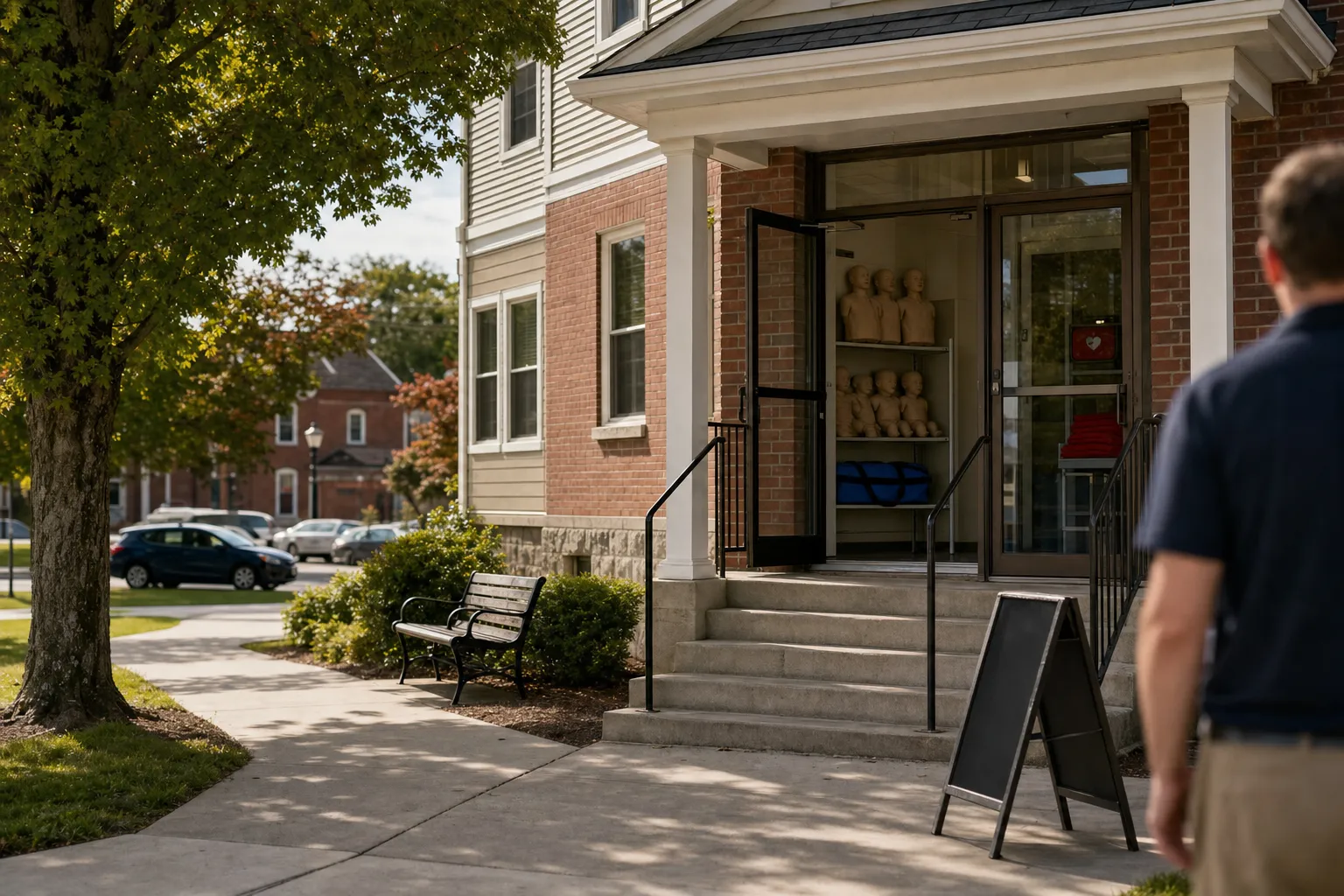
Yes. Blended learning for CPR certification means you complete the knowledge portion online and then attend a short, hands on skills session in person for your practical assessment. At Care First Education we use blended formats when the certifying organization allows it, and we schedule in person skills checks in or near Cokeville so you finish with a valid certificate and confidence in real emergencies.
What blended learning means for CPR certification
Blended learning mixes two parts: online lessons you complete at your own pace, and an in person skills check where an instructor observes hands on chest compressions, ventilations, and AED use. That structure reduces the time you need to spend in class while keeping focused practice and assessment where it matters most. We offer blended options for American Heart Association and American Red Cross courses when those course sponsors permit a blended delivery.
For local workplaces, childcare centers, and healthcare students in and around Cokeville, blended learning is especially helpful when schedules are tight, or when larger groups need the same certification but cannot meet for a full day of classroom time.
Why people choose blended CPR classes
- Flexibility to complete the knowledge modules on your own schedule
- Shorter, focused in person sessions that prioritize hands on skills
- Ability to review video demonstrations and practice guides before the skills check
- Suitable for workplace teams, babysitters, parents, and nursing students who need certification with minimal disruption
We hear three recurring questions from local customers. First, they ask if a blended certificate is accepted by employers or schools. Second, they worry about whether the online portion teaches skills well enough. Third, they ask what the in person session actually covers. We address each one below with clear expectations from our classes.
How we run a blended CPR course at Care First Education
Our blended courses follow a consistent pattern so you know what to expect. Every blended course pairs accredited online content with a skills assessment led by a PQAS certified educator. We recently added American Heart Association Basic Life Support to our offerings and continue to run American Red Cross courses where appropriate.
- Complete the online modules. You get access to the approved course platform, watch short videos, read the core material, and complete knowledge checks. The online portion covers recognition of cardiac arrest, hand placement and compression depth, rescue breathing basics, and AED operation.
- Schedule your skills session. After passing the online knowledge check, you book a short in person session. Sessions focus on deliberate practice of compressions, breaths, and AED pad placement, and on scenario practice relevant to your audience, like infant or child resuscitation for childcare providers.
- Demonstrate competence. During the skills check an instructor observes technique, times cycles, and uses skills assessment tools to document passing performance. We emphasize confidence under pressure and scenario based decision making rather than rote repetition.
- Receive certification documentation. Once you meet the practical standards, we issue the certificate in the format required by the credentialing body so you can provide proof to employers, schools, or licensing bodies.
We teach this way because it balances efficient knowledge delivery with hands on proof of skill. Our educators are PQAS certified and use scenario practice to bridge the online lessons to real life response.
Who is a good fit for blended learning
Blended CPR courses work well for several of our audiences in Stewartstown and nearby Cokeville:
- Healthcare professionals and nursing students who need regular renewals and prefer flexible study
- Babysitters, parents, and daycare staff who need pediatric focused modules followed by a short skills check
- Small businesses and workplace safety teams that need certification for multiple employees
- Community groups and early responders who value scenario practice but cannot attend full day classes
Check that blended learning is right for you
- You can complete online coursework with reliable internet access
- You need the practical skills verified in person
- Your employer or licensing body accepts blended certificates for the course you need
Common concerns and how we address them
Below are local questions we get from Cokeville area customers, and how we handle them.
Is the online training rigorous enough?
The online modules cover the same core knowledge you would get in a classroom, including timing of compressions, compression depth targets, and AED safety. Where written material alone might leave learners unsure, our in person skills check is designed to confirm and correct technique.
Will employers accept a blended certificate?
Acceptance depends on the credentialing organization and your employer. We work with American Heart Association and American Red Cross course materials and issue certificates in the formats those organizations require. Before you enroll, we recommend confirming with your employer or licensing board whether a blended delivery is accepted for your role.
How long is the in person skills session?
Typically 30 to 90 minutes depending on the class level and number of skills you must demonstrate. For example, a basic CPR skills check for lay rescuers will be shorter than a BLS skills session that includes team resuscitation components.
What to expect at your in person skills session
- Arrival and setup. We check your completion of the online modules, review objectives, and assign a manikin for practice.
- Guided practice. Under instructor supervision you rehearse compressions, breaths, and AED pad placement. We focus on timing, hand position, compression depth, and minimizing interruptions.
- Scenario practice. We run short scenarios relevant to your audience, such as choking or a collapse at a workplace, and coach leadership, communication, and safe scene management.
- Skills assessment. The instructor records whether you meet objective performance measures from the certifying course. If you need refinement, we provide immediate feedback and repeat practice until standards are met.
Pro tip: Complete the online modules a day or two before your skills session. That timing helps the knowledge stay fresh and makes the practice more productive.
Watch out: Some employers and licensing boards require instructor led knowledge sessions in addition to online modules. Verify requirements before you enroll so your certification meets the rules that apply to you.
How blended learning supports different course types
At Care First Education we adapt the blended format to the course content and audience. Examples include:
- Infant and child CPR modules followed by a pediatric skills check for childcare staff and parents
- BLS blended courses with multi rescuer team practice for healthcare professionals
- Workplace classes that bundle first aid, CPR, and AED sections so employees can finish knowledge work online and attend a consolidated skills day
We also pair blended classes with scenario practice topics from our site, such as scenario practice and team resuscitation, to ensure the in person session builds real world decision making, not just checklist skills.
Logistics for Cokeville area participants
Care First Education is based in Stewartstown and serves Cokeville and nearby communities. If you live in Cokeville we schedule skills checks at times and nearby locations that minimize travel. When you register we provide directions and a checklist so you arrive ready to practice and demonstrate skills.
Our blended class workflow links the online completion record to the in person session so instructors can focus immediately on hands on coaching.
Preparing for a blended CPR course
Before your in person session
- Finish all required online modules and pass the knowledge checks
- Bring a photo ID and any employer or school documentation that verifies course selection
- Wear comfortable clothing for kneeling and practicing compressions
- Review any pediatric content if your role involves children
Pro tip: If you are taking a combined course like CPR and first aid, review the specific first aid scenarios we list on our first aid training page so you know what to expect during scenario practice.
Quality markers we use to keep blended classes effective
Not all blended courses are equal. We look for these quality markers when designing or selecting blended materials:
- Approved content from credible course sponsors like the American Heart Association or the American Red Cross when applicable
- Clear knowledge checks that require mastery before the skills session
- Short, focused in person sessions with PQAS certified instructors who document objective skills performance
- Scenario based practice that mirrors the likely environments students will face, such as homes, classrooms, or small businesses
These markers help ensure your certificate reflects real readiness rather than only a completed video.
Related topics and next steps
Learn more about blended formats on our Blended Learning Models page, review the pathway for certification on our CPR Certification page, and see local options on our Stewartstown location page. Those pages explain course levels, renewal cycles, and how blended formats link to formal certification requirements.
Frequently asked questions
Is a blended CPR certificate accepted by hospitals and schools?
Acceptance depends on the institution and the certifying organization. We use American Heart Association and American Red Cross materials when appropriate, and we recommend you check with your employer or licensing board before enrolling so the course format meets their requirements.
How long do I have to finish the online portion before the skills session?
Timing varies by course sponsor. Typically you can complete the online modules within a few days to a few weeks. When you sign up we provide the course window and recommend completing the online part shortly before your scheduled skills session to keep the material fresh.
What happens if I do not pass the skills check?
If you need additional practice we give immediate feedback and offer an opportunity to repeat the skills check during the same session or at a follow up session. Our goal is to coach you to the required performance standard, not to issue a pass unless you truly meet the criteria.
Do blended classes include AED training?
Yes. AED operation is included in most blended CPR courses. The online portion covers theory and safety, and the in person session gives hands on pad placement and practice with trainer AEDs.
Key takeaway
Blended learning for CPR certification pairs online knowledge work with a short, supervised in person skills check. It offers flexibility while preserving the hands on practice that matters. At Care First Education we run blended courses with PQAS certified educators, align materials with American Heart Association and American Red Cross guidance when appropriate, and schedule skills sessions for learners in Cokeville and nearby Stewartstown so certificates meet practical and documentation standards.
Learn more and find local sessions
Check our topics and service pages to compare course options, and visit our contact page to view our Google Business Profile and local directions for skills sessions in the Cokeville area.